
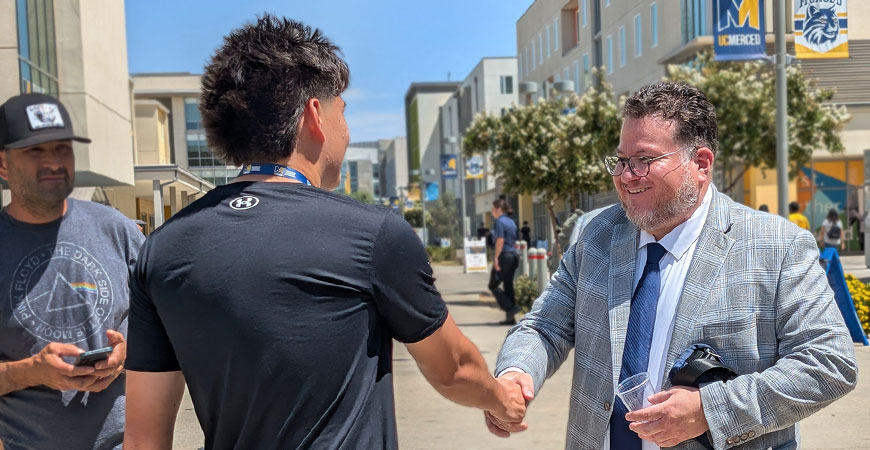
UCLA was a huge change for Jose León. The college transfer student from a small town and a tight-knit extended family struggled to relate to classmates from bigger cities.
Then, at a student resource fair, León met Robin Bueno, the coordinator of a UCLA-based program that helped Native American college students stay on course in their studies. She invited him and other students to a family barbecue.
By the end of that summer, León had a job with the American Indian Student Association, tutoring students throughout the Los Angeles area. At UCLA, he developed life-affirming relationships with numerous Native students.
“Their family experiences were ones I recognized: the way people sit down for a meal and talk, how food is central to their lives, how they value their elders,” León said. “It was like, ‘This is so familiar. I can step into this.’”
Today, León is at UC Merced, bringing more than 25 years of experience in student support and mentoring to his new role as associate vice chancellor and dean of students. His office connects students to resources, supports student success, advocates during personal or academic crises, and helps students navigate challenges of all kinds.
He was dean of students at University of the Pacific for more than three years before coming to Merced. His work in Stockton and earlier roles at UCLA, Cal Poly-San Luis Obispo and the University of Nevada-Reno strengthened his conviction that supporting students starts with appreciating their experience and making a meaningful connection.
"Everyone talks about ensuring that students are college ready. I believe it’s just as important that the college be ready for the student,” León said. “Are we ready to honor and value what they bring to us, that external education?”
Family is a foundation of León’s worldview. His extended family emigrated from Mexico in the 1910s. They worked in the fields in Southern California and his grandparents met in a labor camp. When the camp closed, everyone moved to nearby Santa Paula. The Ventura County town had about 25,000 souls — nearly 60 percent of them Hispanic — when León was a child.
“We all lived on the same block,” he said of family. “I had probably 40 to 50 cousins within yelling distance of my house.”
On a sunny morning in June, León met with University Communications in the Student Affairs office to talk about student success, mentoring and family. The interview was edited for length and clarity.
Tell us more about your grandparents.
My paternal grandfather went to the University of Southern California on the GI Bill, got an engineering degree and had a full career with Caltrans. He was the lead engineer on the original 405 overpass to Sunset Boulevard and UCLA. My maternal grandfather was one of the first Latino investigators in the Ventura County District Attorney’s Office. When I was a kid, my sister and I devoured magazines at his house like Scientific American, Smithsonian Magazine and National Geographic.
My maternal grandmother didn't finish high school, but in her late 20s she and my great-grandmother went to night school and earned their GEDs. My other grandmother also valued education. She learned English later in life, when I was in my teens. Just to show off, she would make me sit and eat while she read an entire newspaper out loud.
What did you learn as a student at UCLA that influences how you work with students today?
One thing I had to learn was how to navigate the bureaucracy. That's a skill all its own. I came from a background that’s more about the people you know, how you relate to them, and what resources or access they have. It's not necessarily ‘OK, I need to fill out this form, or this online submission needs to be done on this timeline to get access to these.’
And sometimes parents and families aren’t comfortable with the requests. My mom, for instance, didn’t want to provide her tax returns for my financial aid application. So, I help families understand what’s needed. In a way, it’s a whole family that’s coming to college, not just a student.
Even a smaller campus like UC Merced can seem big. I want to help students feel they have a home base here, which can make the place seem smaller.
You’ve talked about the importance of mentoring. Tell me about someone who has mentored you.
When I was a young scholar at UCLA, there was a professor named Teo Ruiz, who's now retired. He’s a top scholar in medieval literature. When I transferred from Ventura College, I needed a history class and his was the only one that was open.
About 10 years later, he received the National Humanities Medal from former President Obama.
To this day, Professor Ruiz will answer every email I send him. He was my reference for graduate school. He was a reference for my last job. And I knew he had a full load, teaching 500-student lectures. What I learned from him was humility. If someone as busy as he is, even in retirement, can be that responsive and accessible, I certainly can do the same.
How do you define student success?
My hope for every student is when they find their next path, whether it’s grad school or employment, that when they cross the finish line, they understand it wasn't just about getting a diploma. It was having access to resources and connecting with the people who helped them get the job or graduate program they wanted. They need to have that support to feel connected, to feel a sense of belonging, of community.
We can use a lot of metrics to define student success, and it's great to use data to drive decisions and where we place resources. But at the end of the day, it's about the community we've built to support our scholars so they can become the next generation of leaders.
What is something you learned at University of the Pacific that you brought to UC Merced?
At UOP, we were deeply invested in the student holistically — where they come from, what they're facing and whether it's a challenging or a promising moment.
So one thing I learned at Pacific was to really sit down with a student and understand their story. That may take longer, but in the end, we were able to resolve fundamental issues they faced, not just the superficial problems they came to us with initially.
When we can break down the big problems, create a plan and empower the student to work things out … I’ve seen students who then say, “You know what, I want to help other students.” So, a peer-to-peer support network grows because you took the time to truly listen to one student.
UC Merced’s faculty and staff have an earned reputation of being accessible to students. How will you become part of that?
Students often think the dean of students’ office is like a high school principal’s office — not a place you want to go, right? That’s why it’s important for me and my team to get out of the office and build relationships with students around campus. People need to understand who we are, what we're about.
For a few years, I stepped away from university systems to be a community organizer. I shook hands, I sat down, I listened, I shared meals. With students, making meaningful connections and being truthful about what I do for them is crucial at a university that’s part of the largest higher education system in the nation.
I'm not here to save the day. I’m not here to be Superman. I’m here to help open doors, to help explain things, and to help them become empowered.
